
You've probably spent hours, maybe even days, working on a blog post. But when you publish it, hardly anyone visits. One possible reason? You worked hard on the content but couldn't find a title that grabs readers' attention.
You'll find 30 blog title examples for five different topics, six simple formulas, and practical tips for writing better titles.
30 Blog Title Examples for Different Topics
I grouped these examples by topic, so you can jump straight to your niche. Each group also highlights different ways to approach a headline.
Health and Fitness
- How to Build a 20-Minute Home Workout Routine
- 7 Ways to Make Healthier Food Choices Without Giving Up Flavor
- Why You're Tired After 8 Hours of Sleep
- The Beginner's Guide to Walking 10,000 Steps a Day
- 5 Stretching Mistakes That Can Strain Your Back
- 9 Small Daily Habits That Make Weight Loss Easier
- How-to titles: Show readers how to reach a specific fitness goal.
- Number-based titles: Present practical suggestions in an easy-to-scan format.
- Question-based titles: Address common health concerns and encourage readers to find answers.
- Beginner-focused titles: Make a topic feel more approachable for people just getting started.
Tech and Gadgets
- Best Budget Laptops Under $500 for Students
- 6 Phone Settings That Can Help Speed Up Your Device
- 5 Laptop Features Worth Checking Before You Buy
- Is a Smartwatch Worth It? My Honest Take
- 8 Free Apps That Replace Paid Software
- Wireless Earbuds vs Headphones: Which Should You Buy?
- Buying guides: Help readers narrow down their options within a budget.
- Quick-fix titles: Promise practical steps to improve a device.
- Review titles: Raise a question about whether a product is worth buying.
- Comparison titles: Put two options side by side to support a buying decision.
Travel
- 3 Days in Cape Town: What to See and Do
- How to Travel Europe on $50 a Day
- 5 Packing Mistakes That Can Disrupt a Carry-On Trip
- Is Bali Worth the Hype? Pros, Cons, and Costs
- 10 Hidden Beaches in Thailand Tourists Miss
- The Best Time to Book Flights for a Summer Vacation
- Itinerary titles: Give readers a clear idea of what they can do during a trip.
- Budget-focused titles: Show how to travel while keeping costs down.
- Mistake-based titles: Highlight problems travelers may want to avoid.
- Destination titles: Spark interest in places readers may not know about.
- Question-based titles: Help readers weigh the advantages, drawbacks, and costs of a trip.
Food and Recipes
- 15-Minute Chicken Dinners for Busy Weeknights
- How to Fry Eggs Without Burning Them
- 7 Mistakes That Make Your Pasta Taste Flat
- Meal Prep for Beginners: A Simple 5-Day Plan
- Why Your Cookies Spread (and How to Fix It)
- 12 Cheap Dinners Under $5 a Serving
- Time-based titles: Appeal to readers who need quick meal ideas.
- Instructional titles: Focus on getting a cooking technique right.
- Mistake-based titles: Help readers understand what may be going wrong with a recipe.
- Beginner-friendly titles: Break meal planning into manageable steps.
- Budget-focused titles: Make the cost of each meal clear upfront.
Finance and Business
- How to Build a $1,000 Emergency Fund in 3 Months
- 10 Money Mistakes People Make in Their 20s
- Side Hustle Ideas You Can Start With $0
- Should You Pay Off Debt or Invest First?
- How to Price Your Freelance Work Without Guessing
- 5 Budgeting Apps That Make It Easier to Track Spending
- Goal-based titles: Give readers a specific financial target and timeframe.
- Mistake-based titles: Point to habits that may be worth changing.
- Low-cost opportunity titles: Attract readers looking for ways to start earning without an initial investment.
- Decision-based titles: Present a choice that needs careful consideration.
- Practical tool titles: Introduce apps that can help readers manage their money.
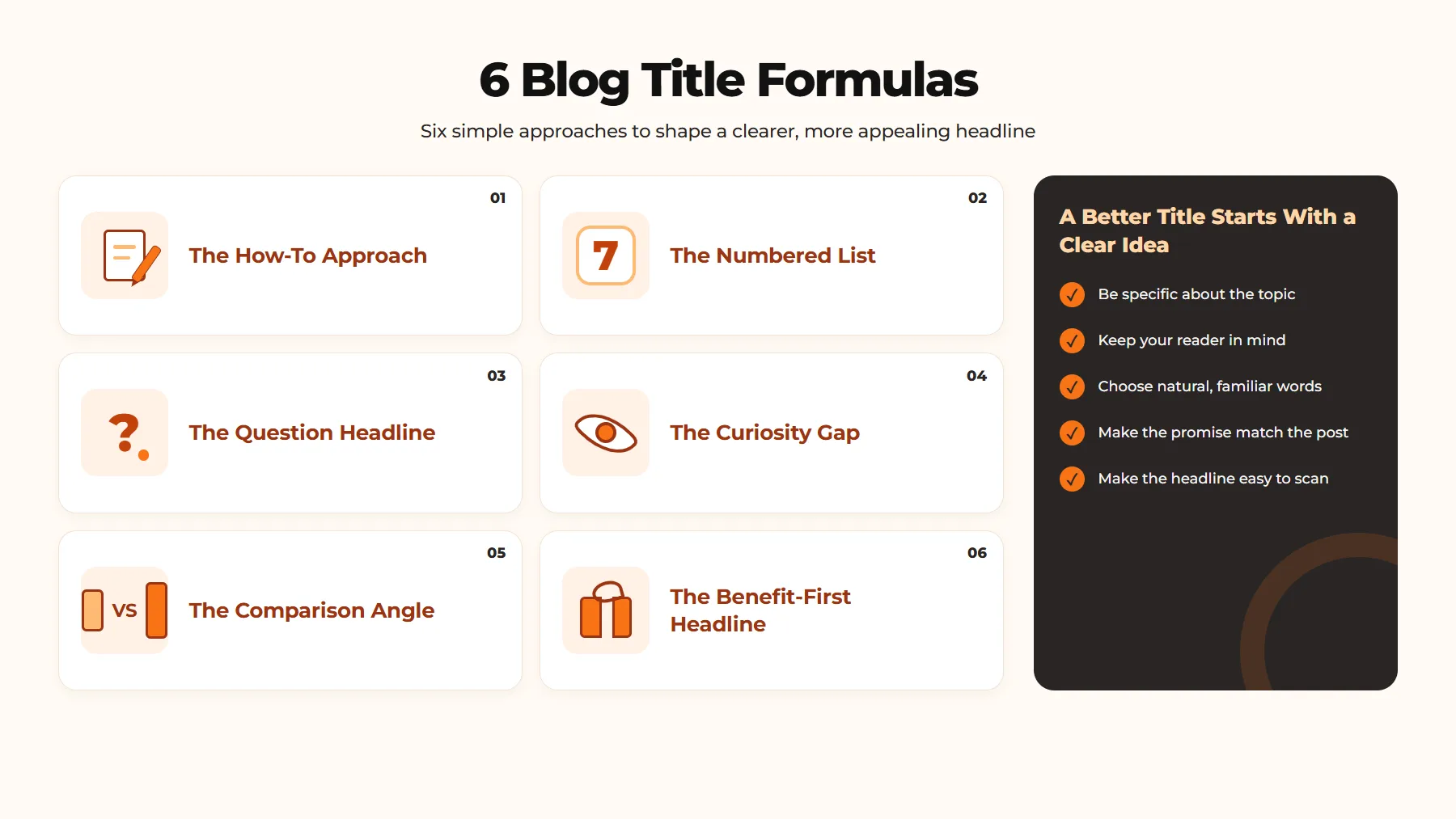
6 Blog Title Formulas You Can Copy
These formulas give you starting points when you're unsure how to phrase a headline. Replace the words in brackets with details that fit your article.
The How-To Formula
Template: How to [Result] Without [Pain Point]
Examples:
- How to Pick a Blog Topic Without Second-Guessing Yourself
- How to Write Catchy Titles Without a Marketing Degree
Use it for: Step-by-step posts that explain how to complete a task or solve a particular problem.
The Numbered List Formula
Template: [Number] [Adjective] [Topic] That [Result]
Examples:
- 7 Simple Title Changes That Can Help Attract More Clicks
- 8 Common Blogging Mistakes That Can Hurt Your Readers' Experience
This works well for: Articles that bring several tips, tools, mistakes, or ideas together in one place.
The Question Formula
Template: [Why/Is/Should] [Doubt Your Reader Has]?
Examples:
- Is Your Blog Title Costing You Clicks?
- Why Are Readers Skipping Your Blog Posts?
Try it when: Your article addresses a specific question or decision people want help with.
The Curiosity Gap Formula
Template: Your [Assumed Problem] Isn't the Issue. [What Needs Attention] Is.
Examples:
- Your Blog Post Isn't the Problem. Your Title May Be.
- Your Recipe Isn't the Problem. Your Oven Temperature Is.
Use this approach for: Opinion pieces and articles that challenge an assumption. The content should explain the unexpected point rather than leave readers with an empty promise.
The Comparison Formula
Template: [Option A] vs [Option B]: Which Is Better for [Audience or Purpose]?
Examples:
- WordPress vs a Custom Website: Which Is Better for a Small Business?
- Freelancing vs a Full-Time Job: Which Fits Your Goals?
This formula suits: Comparison articles that help readers understand the differences between two products, methods, or choices.
The Benefit-Driven Formula
Template: [Achieve a Specific Benefit] Without [Common Difficulty]
Examples:
- Save on Travel Costs Without Missing the Best Attractions
- Plan a Week of Meals Without Spending Hours in the Kitchen
Choose this format when: Your article offers a clear outcome and shows readers what they can gain from following the advice.
Tips to Make Your Blog Titles Better
Once you have a title idea, give it a quick edit before using it. A few small changes can make it more useful and appealing to the right readers.
- Use your main keyword naturally. If you're targeting a particular search term, include it where it fits without making the title sound awkward. You don't need to repeat the same keyword or force it into an unnatural phrase.
- Think about search intent. Consider what someone expects to find when searching for your topic. A person looking for a beginner's tutorial needs a different headline from someone comparing two products. Make sure your wording reflects the kind of answer your article provides.
- Remove filler words. Phrases like "a guide to," "everything you need to know about," and "some ways to" can make a title longer than necessary. Cut them when they don't add anything.
- Choose stronger verbs. Instead of "Ways to Make Your Writing Better," try "Improve Your Writing With These Simple Changes." A more active phrase can make a title sound more engaging.
- Keep it concise. Remove words that don't help readers understand the topic or its value. Shorter titles are often easier to scan, but don't cut useful details just to reach an arbitrary character count. For title capitalization, check out my post Sentence Case vs Title Case.
- Avoid unnecessary punctuation. Too many commas, exclamation marks, or question marks can make a headline look messy. Keep the structure simple.
- Don't force a date into every title. Add a year only when the information is genuinely time-sensitive or regularly updated. Otherwise, it can make an evergreen post look outdated later.
- Make sure the title matches the article. Don't promise a result, list, or solution that the post doesn't actually deliver. Include specific details only when your content supports them.
- Check how your title fits with other posts on your site. If two posts have nearly identical headlines, readers may have trouble telling them apart. Give each one its own wording and focus.
Before and After: Improve These Blog Titles
Sometimes a title doesn't need a completely different idea. A few specific details can make the subject easier to understand.
| Basic title | More specific version |
|---|---|
| Gardening Tips | 9 Gardening Tips for Growing Herbs in Small Spaces |
| Freelance Pricing | How to Set Freelance Rates When You Have No Portfolio |
| Email Marketing Ideas | 9 Email Marketing Ideas for Small Online Stores |
| Study Tips | 7 Study Habits That Help College Students Remember More |
| Dog Training | How to Stop Your Dog From Pulling on the Leash |
| Small Bathroom Ideas | 8 Small Bathroom Storage Ideas That Free Up Floor Space |
| Portrait Photography | How to Take Better Portraits in Natural Light |
| Toddler Sleep | How to Help Your Toddler Settle Into a Bedtime Routine |
| Car Maintenance | 5 Car Checks to Make Before a Long Road Trip |
| Wedding Planning | A 6-Month Wedding Planning Checklist for a Small Ceremony |
The revised versions give readers a better sense of the topic, audience, or scope. They also make it easier to decide whether the article is relevant to what they're looking for.
How I Come Up With a Title for a Blog Post
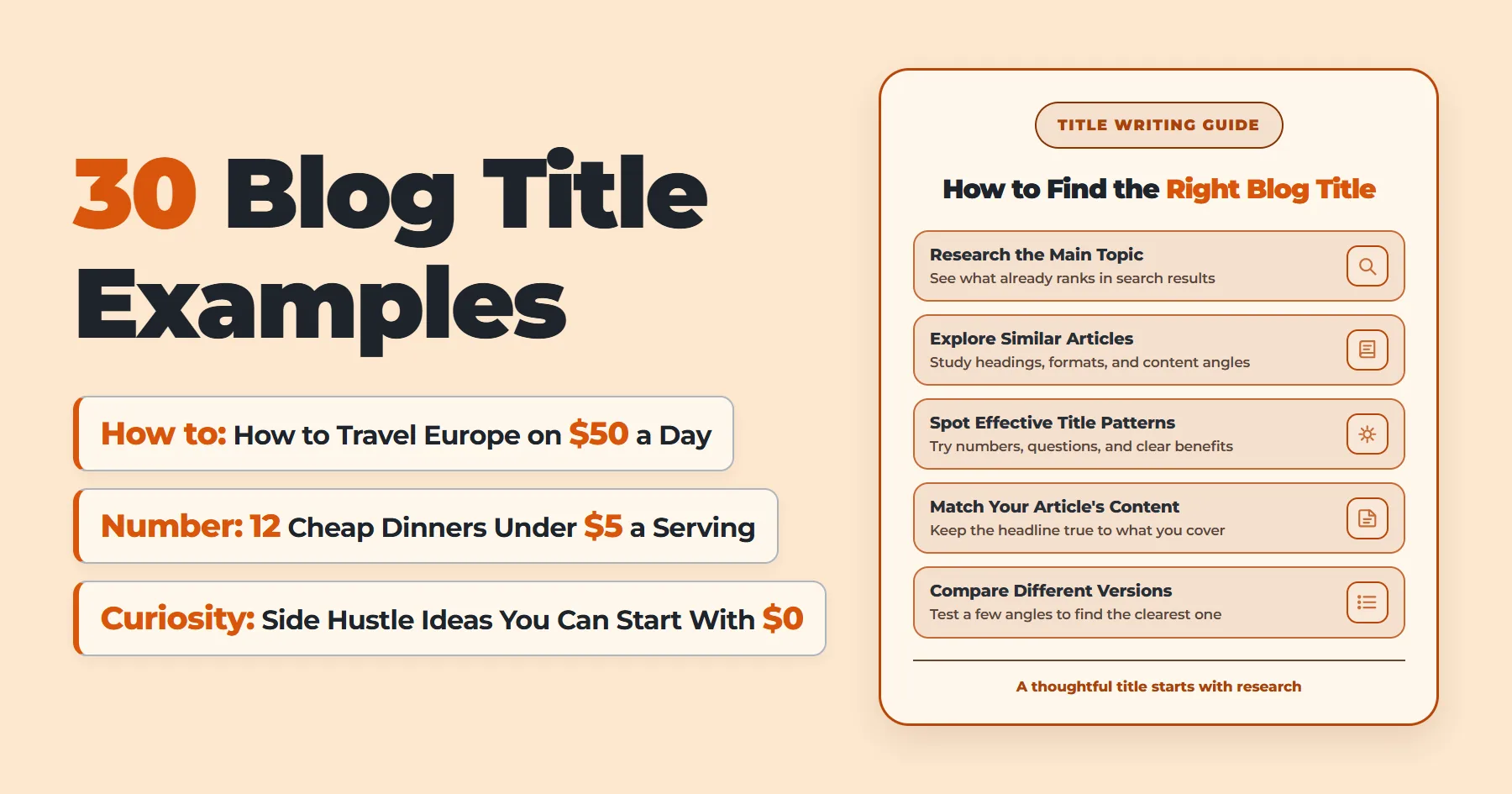
When I need ideas for a blog title, I don't just write down the first few phrases that come to mind. I look at what's already ranking and how other writers approach the same subject.
Here's the process I follow:
- Search for the main topic. I start with the topic or search phrase and look at the pages appearing in the results. This gives me an idea of what readers are already finding.
- Explore relevant pages in the same niche. I open a few useful results and look at their titles, headings, and examples. I also check whether they focus on tutorials, lists, comparisons, common problems, or another angle.
- Look for useful title patterns. I note how writers use numbers, questions, specific outcomes, and audience details. I don't copy their titles. I use these patterns to explore different ways to present my own topic.
- Check what my article actually covers. I list its main points, examples, intended readers, and the information that makes it useful. This helps me avoid writing a title that promises more than the article delivers.
- Write a few different versions. I try different approaches, such as a how-to title, a question, or a benefit-driven headline. Then I compare them to see which one communicates the topic most clearly.
- Read it alongside my opening paragraph. A title sets an expectation, and the introduction should keep it. I read both together, and if the intro doesn't deliver what the title suggests, I change one of them.
Finally, I simplify any wording that feels awkward. This process gives me more useful options than choosing a headline just because it sounds catchy.
Frequently Asked Questions
Can I change my blog title after publishing?
Yes. You can update a blog title whenever the existing one no longer represents the post well. Just make sure the new wording still matches the content. If you also change the URL, set up a proper redirect from the old address.
Should my SEO title and H1 be the same?
They don't have to be identical. Your SEO title is written for search engines, while your H1 is the main heading readers see on the page. Google may use your SEO title in search results or generate a different title based on the page.
I keep the SEO title and H1 different in every post on my site. You can word them differently as long as both accurately describe the same article.
Can I use a title generator for my blog?
Yes. A title generator can give you ideas when you're stuck or help you explore different ways to phrase a topic. Treat its suggestions as drafts rather than finished headlines. Review each one and make changes to fit your actual content.
Final Thoughts
Before settling on a title, think about what a reader should understand or gain from your post. A clear headline gives them a reason to choose your article and helps them know what to expect before they click.
Explore different approaches, try a few versions, and compare your results. The blog title examples above can help you choose a headline that communicates your article's value clearly. To see how a strong title fits into a full post, you can see these blog writing examples.