
Blog introduction examples are easy to find and hard to use. Many articles show you famous intros, then leave you alone with a blank page. This article fixes that. You get 15 original examples across hooks, formulas, niches (specific topic areas) and rewrites. Each one is short enough to adapt in a minute. First comes a four-part formula, then the examples, and finally a checklist to test your own intro.
The 4-Part Formula for a Blog Introduction
A blog introduction is the opening of a post, usually 3 to 5 sentences. Most good intros share four parts, and you can write each one in a sentence or two.
- Hook: an opening line or two that earns the next sentence.
- Context: the problem or situation your reader is facing.
- Promise: what they will be able to do after reading.
- Roadmap: a single line on what the post covers.
That said, you do not need all four every time. A quick-answer or reference post can skip the hook, and an opinion post can combine hook and context. But when an intro feels weak, one of these four is usually missing.
A Filled-In Example
Here is the formula applied to a post about writing a first blog post:
- Hook: Your first blog post will probably be your worst, and that is fine.
- Context: Many new bloggers spend days polishing the opening and delay publishing.
- Promise: This guide helps you write a clear first post in one sitting.
- Roadmap: It covers the title, the opening, and a simple structure you can reuse.
Together, those four lines make a complete intro of about 50 words.
6 Blog Introduction Examples by Hook Type
These six hook types give you a practical starting point for many kinds of blog posts. Each of these blog introduction examples is original, so you can copy the structure and swap in your own topic.
Question Hook
What would you rewrite first if most visitors never read past your second sentence? For most blogs, the answer is the introduction. Here is how to fix yours in ten minutes.
Use it when: your reader has a problem they have not put into words yet.
Number Hook
Four parts. That is all most introductions need: a hook, the context, a promise and a roadmap. Learn them once, and starting a post gets easier.
Use it when: you have a number you can stand behind, such as a count, a time or a number of steps from your own process. If you later get a figure from your analytics (your site's traffic data) or a source you can cite, use that instead. Never invent a number.
Story Hook
You spend three days on a post, hit publish, and watch twelve people visit. Then you open your analytics and see that most of them left within seconds. The post was not the problem. The first three sentences were.
Use it when: the topic is personal or emotional. Keep the story to four sentences or fewer and tie it to the problem right away.
Contrarian Hook (going against the common belief)
Posting every day will not grow your blog. It will only make your weakest posts easier to find. Here is what to do instead.
Use it when: you can back the claim in the body. A bold opening with no proof is just clickbait (a misleading promise made only to get clicks).
"What If" Hook
What if your next post needed no warm-up at all? No "in today's digital world", no definition, no backstory. Just the answer in the first line and the proof right after.
Use it when: you are selling a better way of working. The reader should be able to picture the result.
Pain-to-Gain Hook
You sit down to write, type the first sentence, delete it, and type it again. Forty minutes later the page is still blank. There is a simpler way to start, and it takes about five minutes.
Use it when: the post teaches a skill. Describe the pain first and promise the fix, but do not reveal it yet.
Which Hook Should You Use?
Match the hook to the post type, and you will rarely get stuck. This is a rule of thumb drawn from the blog introduction examples above, not a law.
| Post type | Best hook | Why |
|---|---|---|
| How-to guide | Pain-to-gain | The reader wants the fix, so start with the pain |
| Listicle (a post built as a list) | Question or number | Sets up the list quickly |
| Review or comparison | Skip the hook, use a clear preview | The reader is deciding and wants to know what you compare |
| Opinion piece | Contrarian | The opinion is what readers come for |
| Personal story | Story | Builds trust before the advice |
When two hooks fit, pick the one you can finish in two sentences.
Blog Introduction Examples Using Copywriting Formulas
When no hook comes to mind, a copywriting formula tells you what to write, one step at a time. Two of them suit blog posts well. Drop the labels when you write your own.
PAS (Problem, Agitate, Solve)
Problem: Your online shop looks great, but visitors leave before the page finishes loading. Agitate (make the problem feel more urgent): Every second of waiting sends a few more of them back to the search results. The products you worked hardest on never get seen. Solve: The cause is often a few oversized images, and this guide shows you how to find and fix them.
Use it when: the post solves a clear problem. Two sentences of agitation are enough, so do not overdo it.
BAB (Before, After, Bridge)
Before: Every Sunday you plan to cook for the week, and every Wednesday you are ordering takeaway. After: Picture a fridge with five ready lunches and an hour of your weekend still free. Bridge (the step that connects the "before" to the "after"): A simple batch-cooking routine gets you there. The rest of this post shows each step.
Use it when: the result is easy to picture and the reader can see the gap between now and then.
Blog Introduction Examples by Niche
The structure stays the same across topics. Each of these blog introduction examples opens with a problem and ends with a promise, so you can adapt them to your own topic.
Tech Blog Introduction
Your laptop fan is loud, your battery is dead by lunch, and you have not opened your settings in two years. Yet the slowdown often comes from a handful of defaults, not old hardware. So here are five default settings to change first, starting with the one that helps the most.
Food Blog Introduction
Rice that comes out gluey is rarely a cooking-time problem. More often, it is a water-ratio and rinse problem. This recipe fixes both, so the pot comes out fluffy on the first try.
Travel Blog Introduction
A five-day trip with only a carry-on sounds impossible until you see what actually gets worn. In fact, many people pack outfits they never touch. So here is the exact list I would bring, and what I would leave at home.
Personal Finance Blog Introduction
Saving feels impossible when every month ends with nothing left. But the leak is often not a big purchase; it is a few forgotten subscriptions. This guide shows you how to find them in ten minutes, and then which to cancel first.
Before and After: 3 Blog Introductions Rewritten
Fixing a weak intro teaches more than admiring a strong one. Here are two common problems and one from my own writing, rewritten.
A Generic Opening, Rewritten
Before: "Welcome to my blog! Today I want to talk about something many people find interesting: healthy eating."
After: "Many diets fall apart once real life gets in the way, and the cause is rarely willpower. It is usually a plan that asks too much on a busy weeknight. Here is a simpler way to eat well."
Why it works: the first version greets the reader and promises nothing. The second names the real reason people quit.
An Intro That Runs Too Long, Rewritten
Before: "Coffee is one of the most popular drinks in the world. People have enjoyed it for centuries, and it comes in many forms, from espresso to cold brew. Whether you like it hot or iced, strong or mild, there is a method for everyone. In this post, I will explain how to brew a better cup at home."
After: "Your home coffee often tastes flat for one of two reasons: the water or the grind. Fix those two and the same beans can taste noticeably better. Here is how."
Why it works: the background is gone, and the reader meets the problem in the first line.
My Own Intro, Rewritten
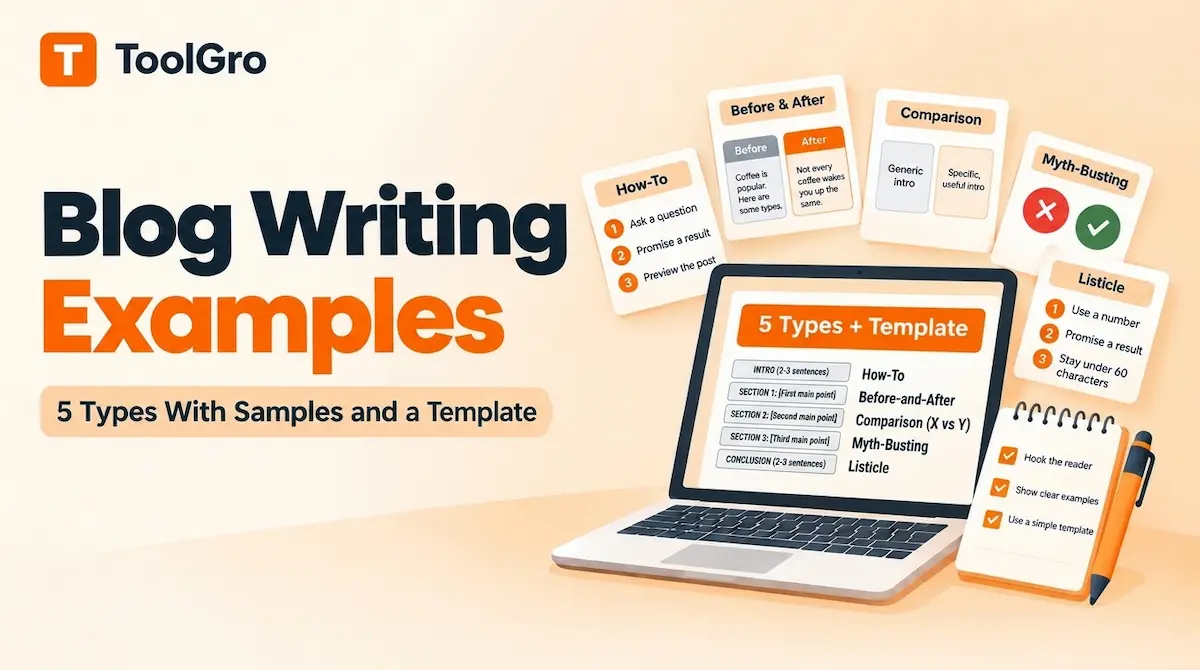
I looked back at the intro of my first ToolGro post, which shares blog writing examples for five types of blog posts. My first draft opened like this.
Before:
"You've probably read many different types of blog posts, from how-to guides and food blogs to personal stories and comparison posts. But if a blog post isn't written well, it may not attract readers. Let me show you five blog writing examples to help you understand what a good blog post should look like."
After (the version now live on the post):
"This article presents five types of blog posts, along with blog writing examples illustrating how each one functions. You will learn why each type is useful and when to use it.
Whether you are a beginner, a student, or a new blogger, these blog writing examples will help you understand how to write different types of blog posts. You will find sample posts, a simple template for planning your content, and answers to frequently asked questions. By the end, you will know which format fits your topic and how to start without overcomplicating things."
Why it works: the first version spoke to the reader but never said what the post would give them. The second names the five post types, the audience, the template and the FAQs. So the reader knows what they will get before the first heading.
The lesson: an intro that says exactly what the reader will find is easier to commit to than one that only sets the mood.
What I Found in Six Ranking Pages
My own intro is only one case, so I looked at how other pages open. I studied six pages that rank for blog introduction examples. Four show example intros within the first few lines. Three pose a question in the opening, one opens with a quote, and none leads with a statistic. Six pages is a small sample, so treat this as a quick observation rather than proof.
| Page | How the intro starts | Hook type |
|---|---|---|
| Empire Writer | A quote, then a short confession: the author built a freelance career without being great at intros | Quote + personal story |
| Lean Labs | A question about hooking a reader quickly, then the roadmap arrives a few paragraphs in | Question |
| Grow and Convert | Two CRM (customer relationship management) intros as screenshots, a "which do you prefer?" prompt, then several paragraphs of background | Example comparison + question |
| Digital Leverage | Two intros on the same topic as screenshots, then "Which is better?" | Example comparison + question |
| Write To Done | A party analogy with two scenarios, then example intros right after | Analogy + examples first |
| Mint Studios | A direct statement that readers have seen plenty of terrible intros, followed by four examples of bad intros | Statement + bad intro examples |
Which of the Six Pages Was Clearest
In my view, Mint Studios was the clearest of the six. It states the problem, shows what goes wrong, and gives three ways to fix it. It also adds a fair note that generic intros can work for educational posts. Within these six, the pages that reached the point fastest felt the easiest to read.
Should You Start a Blog Post With a Question?
Opening with a question is common advice, but some writers disagree.
Against: Mint Studios calls generic opening questions a cliché. Similarly, Digital Leverage advises cutting questions whose answer is obvious, since the reader already knows it. Lean Labs also files the "Have you ever..." opening under bad introductions.
Where they agree: the question has to be specific. If the reader can answer it with "obviously", it is filler.
My view: Lean Labs' opening question was the strongest of the three that open with one, because it names a clear problem. So I use a question only when it points at a specific pain. When it does not, I state the problem directly.
How Long Should a Blog Introduction Be?
Aim for 3 to 5 sentences, roughly 50 to 150 words. That is my working range, not a rule. A quick how-to can open in two sentences. A story-led post can stretch to six, as long as the reader learns early what they will get.
Also, write the introduction last. Once the body is finished, you know what the post really delivers, so the promise you make will be true.
Blog Introduction Checklist
Read your draft against these points before publishing.
- The first sentence is about the reader, not about you or the history of the topic.
- The problem or benefit shows up within two sentences.
- There is one clear promise, and the post keeps it.
- No filler openers such as "In today's world".
- It stays under about 150 words.
- One line tells the reader what comes next.
- Read aloud, it sounds like you.
Blog Introduction FAQs
How Do I Start a Blog Introduction?
Write down the single idea you want the reader to leave with, and open with it in plain words. Then follow with a sentence of context and a line on what comes next. The first line can be polished after the rest is done.
What Makes a Good Blog Introduction Example?
Good blog introduction examples are short, specific and truthful. The right reader recognizes themselves in the intro within a few seconds, and the post then delivers what it promised.
How Do You Write an Introduction for a Personal Blog or a Student Post?
On a personal blog, say who you are in one line and what readers will get here. For a student post, lead with the question or argument you are answering rather than general background. Keep either one to a few sentences.
Final Thoughts
The best way to use these blog introduction examples is to try one on a real post. Take your latest draft and pick the hook that matches its type from the table above. Then rewrite the intro in a few minutes, check it against the checklist, and keep the version that sounds more like you. Once your opening works, give the ending the same care. Here is how to write a good conclusion.