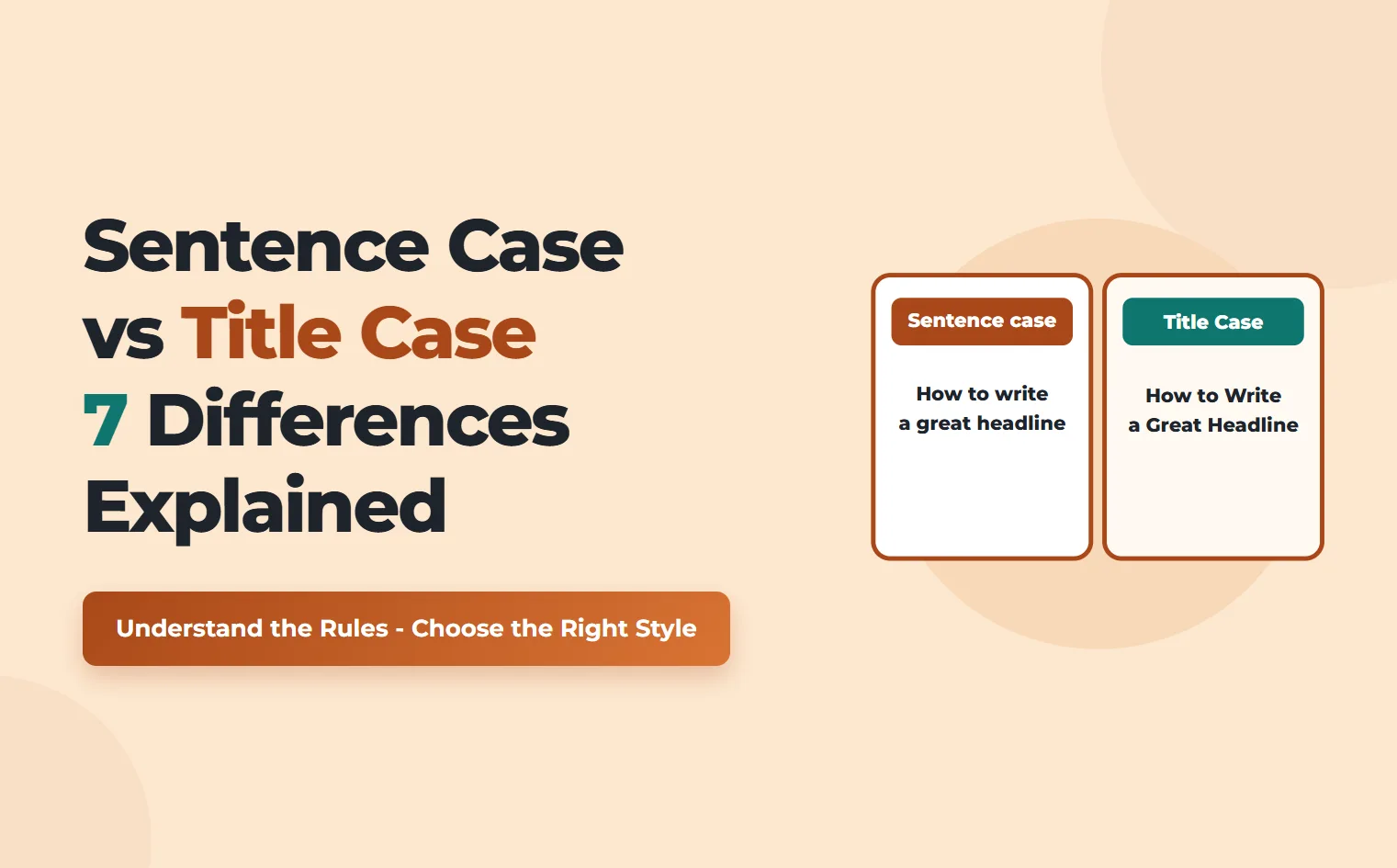

Whenever you write a heading, headline, or button label, the sentence case vs title case question comes to mind: Which one should you use? Here's the simple answer:
- Sentence case: Capitalizes the first word and any other words that normally require capitals, such as proper nouns (specific names) and acronyms (abbreviations like SEO).
- Title case: Capitalizes the first and last words and most major words in a title.
Sentence Case vs Title Case: Examples
| Style | Example |
|---|---|
| Sentence case | Opportunities in the month of November |
| Title case | Opportunities in the Month of November |
What Is Sentence Case?
Sentence case means writing a title or heading just like a regular sentence. Capitalize the first word and leave the rest lowercase unless there's a specific reason to capitalize a word.
Sentence Case Rules
Here are the rules, each with an example:
- Capitalize the first word. Whatever the word is, it starts with a capital letter.
Example: Why your morning routine matters - Capitalize proper nouns. Names of people, places, brands, days, and months keep their capital letters.
Example: Best hiking trails near Denver for beginners - Capitalize the first word after a colon. Many style guides capitalize the first word after a colon when what follows is a complete sentence, though the exact rule depends on the guide.
Example: The big question: Should you quit your job? - Always capitalize "I." This includes contractions like "I'm" and "I've."
Example: Everything I learned from my first year of freelancing - Keep acronyms in all caps. Letters like SEO (search engine optimization) or NASA stay uppercase wherever they appear.
Example: What is SEO and why does it matter
Everything else, including words like "the," "and," and "of," stays lowercase, no matter how important the word feels.
What Is Title Case?
Title case capitalizes most words in a title, giving important words more emphasis. Short connecting words usually stay lowercase. It's a classic style you'll commonly see on book covers, magazine articles, and movie titles.
Title Case Rules
Here are the rules, with examples.
- Always capitalize the first and last word. This holds even when that word is small.
Example: Where Great Ideas Come From - Capitalize the major words. That means nouns, pronouns, verbs, adjectives, and adverbs.
Example: How Small Habits Quietly Change Your Life - Capitalize forms of "to be." Words like "is," "are," and "be" are verbs, so they get a capital letter even though they are short.
Example: Why Sleep Is Important - Lowercase articles. That means "a," "an," and "the," unless they open or close the title.
Example: A Day in the Life of a Freelancer - Lowercase short conjunctions. Words like "and," "but," and "or" stay small.
Example: Save More and Spend Less - Usually lowercase short prepositions. Words like "to," "for," "of," "in," and "on" generally stay lowercase, but the rules vary by style guide and usage.
Example: A Beginner's Guide to Saving for Retirement - Lowercase "to" in an infinitive. An infinitive is the base form of a verb, such as "to write." In APA, Chicago, and MLA, "to" stays small when it comes before a verb.
Example: How to Write a Better Headline - Keep proper nouns and acronyms capitalized.
Example: Why SEO Still Matters in Google Search - Capitalize the first word after a colon.
Example: Productivity Myths: What Actually Works - Capitalize both parts of most hyphenated words.
Example: 10 Well-Known Habits of Happy People
One thing to know before you start applying these rules: there isn't just one way to write in title case. AP, APA, Chicago, and MLA share many basic principles, but they differ in how they capitalize prepositions and conjunctions.
For example, AP and APA capitalize prepositions with four or more letters, so you would write "Tips for Writing With Confidence." Chicago (18th edition) lowercases prepositions of four letters or fewer, while MLA lowercases prepositions of any length. Both would write "Tips for Writing with Confidence." I'll break down each style in detail in the sections below.
Sentence Case vs Title Case: 7 Key Differences
Both styles have their place, but they differ in how they handle capitalization, appearance, and where they're commonly used. Here is how the two differ in seven ways.
| Difference | Sentence case | Title case |
|---|---|---|
| Capitalization | First word, proper nouns, "I," and acronyms | First and last words, plus major words |
| Readability | Simpler look, especially in long headings | More prominent, traditional look |
| Tone | Often casual, friendly, and conversational | Often formal, polished, and traditional |
| Style guides | AP headlines; Google, Microsoft, GOV.UK | Chicago, MLA, APA headings and work titles |
| Common uses | Blogs, news, apps, and UX copy | Books, movies, magazines, and academic headings |
| Consistency | Fewer capitalization decisions | More capitalization rules to follow |
| Ambiguity | Proper nouns are easier to spot | Proper nouns blend in with other capitalized words |
| Example | How to build a morning routine that sticks | How to Build a Morning Routine That Sticks |
1. Capitalization Rule
One key difference is how each style capitalizes the words that follow the first word. In sentence case, most words stay lowercase. In title case, major words are capitalized. For example, "Why small habits beat big goals" becomes "Why Small Habits Beat Big Goals."
2. Readability and Scanning
For longer headings, sentence case can make the text feel less crowded because fewer words begin with capital letters. This can be especially useful for subheadings that readers scan quickly.
3. Tone
Sentence case often sounds casual and friendly, while title case often sounds formal and polished. The tone also depends on the context. A casual blog may use sentence case to keep its headings consistent with the rest of the writing, while a book title may use title case to follow traditional publishing conventions.
4. Which Style Guide Uses Which
The exact rules depend on the style guide. AP uses sentence case for headlines, while Google, Microsoft, and GOV.UK recommend sentence case for headings. APA uses title case for paper headings and titles of works in running text, but sentence case for titles in reference lists. MLA and Chicago use title case for English-language work titles.
5. Where Each One Is Used Most
Sentence case is common on blogs, news sites, apps, and UX copy, while title case is common for books, movies, magazines, and academic headings. If you're unsure, follow what others in your field do.
6. Consistency
Whichever style you choose, apply it consistently across your website or document. If you follow a style guide, use its rules rather than switching between different capitalization styles.
7. Ambiguity
In sentence case, capitalization can help distinguish a proper noun from a common noun. For example, "Why Mercury matters" can refer to the planet, while "Why mercury matters" can refer to the chemical element. In title case, both would look the same: "Why Mercury Matters."
Sentence Case vs Title Case: What Each Style Guide Recommends
Here is how the major style guides handle capitalization:
AP (Associated Press)
- Style: Sentence case
- Used for: News headlines
- Example: Tips for writing with confidence
APA (American Psychological Association)
- Style: Title case for paper titles, headings, figure titles, and table titles.
- Sentence case: Titles in reference list entries. Journal titles remain in title case.
- Example: Tips for Writing With Confidence (title case) / Tips for writing with confidence (sentence case)
MLA (Modern Language Association)
- Style: Title case
- Used for: English-language work titles
- Example: Tips for Writing with Confidence
Chicago Manual of Style
- Style: Title case
- Used for: Work titles and headings
- Example: Tips for Writing with Confidence
- Style: Sentence case
- Used for: Titles, headings, and captions
- Example: Tips for writing with confidence
Apple
- Style: Varies by UI (user interface) element; consistency matters.
- Used for: App interfaces
- Examples: Get Started / Get started
Microsoft
- Style: Mostly sentence case, with some exceptions.
- Used for: Headings, titles, and UI labels
- Example: Tips for writing with confidence
GOV.UK
- Style: Sentence case
- Used for: Headings
- Example: Tips for writing with confidence
Title Case Rules: AP, APA, Chicago, and MLA
Each style guide has its own rules for capitalizing shorter words, especially prepositions and conjunctions. Here's how AP, APA, Chicago, and MLA handle them.
AP Style
- Capitalize prepositions and conjunctions of four or more letters.
- Lowercase articles, conjunctions, and prepositions of three letters or fewer, unless they are the first or last word.
- Use capital letters for the opening and closing words of a title.
Example: Learning From Mistakes ("From" has four letters, so it is capitalized.)
AP uses these rules for titles of books, movies, and songs. Its news headlines use sentence case.
APA Style
- Capitalize every word of four letters or more, including prepositions like "With" and "From."
- Capitalize verbs, including short ones like "Is," "Are," and "Be."
- Lowercase articles, conjunctions, and prepositions of three letters or fewer, unless they are the first word.
- Capitalize the first word after a colon.
Example: Why Sleep Is Important ("Is" is capitalized because it is a verb.)
Chicago Style (18th edition)
- Capitalize prepositions of five or more letters, such as "Through" and "Between."
- Lowercase prepositions of four letters or fewer, unless they are part of a phrasal verb.
- Lowercase articles and coordinating conjunctions (and, but, for, or, nor).
Example: Learning from Mistakes ("from" has four letters, so it stays lowercase.)
MLA Style
- Lowercase prepositions of any length, unless they are the first or last word.
- Lowercase articles and coordinating conjunctions (such as and, but, or).
Example: Learning from Mistakes
When to Use Sentence Case vs Title Case
The right choice depends on where your text will appear. Here are some common situations and the style that works well for each.
Blog Headlines
Either one works. Sentence case is a simple, consistent choice, but use title case if your publication's style guide requires it.
Example: 7 simple ways to save money or 7 Simple Ways to Save Money
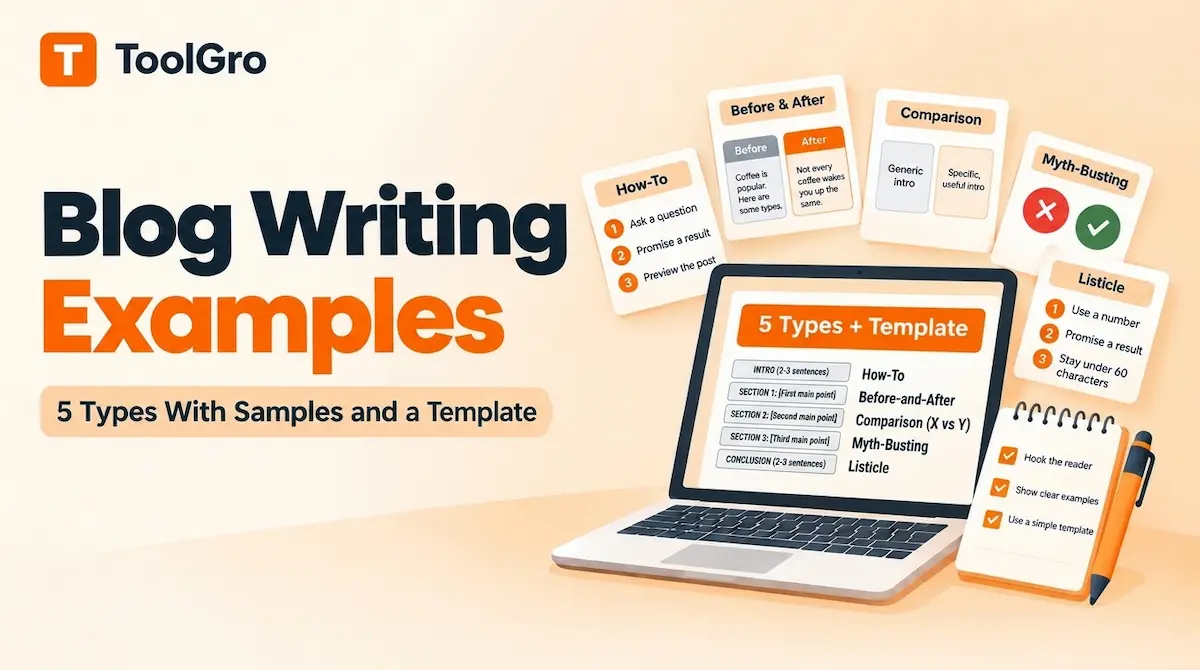
See my article on 5 blog post types with examples.
Email Subject Lines
Sentence case is a natural choice for email subject lines.
Example: Your order has shipped
Buttons and CTAs
Sentence case is a common choice for website and app buttons and CTAs (calls to action). Microsoft, for example, recommends sentence case for UI text. Check the relevant platform guidelines if you're designing for a specific product.
Example: Add to cart
YouTube Titles
Either one works. Choose the style that suits your channel and use it consistently.
Example: How I Learned to Code in 6 Months or How I learned to code in 6 months
LinkedIn and Social Media
Use sentence case for regular posts. It follows the capitalization of everyday writing. You can use title case for the titles of books or articles you mention.
Example: Three lessons I learned from my first year as a manager
Resumes
Title case works well for section headings and job titles used as headings. Use normal sentence capitalization for bullet points, and keep the formatting consistent.
Example: Marketing Manager, Work Experience
Academic Papers
Follow the style required by your teacher, institution, or journal.
Example: Effects of Sleep Loss on Reaction Time
Book Titles
When mentioning a book in your writing, follow the capitalization used in its published title.
Example: To Kill a Mockingbird
Does Sentence Case vs Title Case Affect SEO and Clicks?
Not directly. Capitalization is not a known ranking factor, so changing a title from sentence case to title case is unlikely to improve rankings on its own. However, capitalization affects how a title looks in search results and may influence clicks. Which style gets more clicks depends on your audience.
What I found in the search results: In November 2026, I checked ten pages from the search results for this keyword and compared their titles and subheadings.
How Top Websites Capitalize Their Headings
| Page | Title in Google | Subheadings |
|---|---|---|
| Grammarly | Title case | Sentence case |
| Title Case Converter | Title case | Title case |
| Tempertemper | Sentence case | Sentence case |
| UX Collective | Sentence case | Mixed |
| APA Style | Sentence case | Sentence case |
| Australian Government Style Manual | Sentence case | Sentence case |
| ASCENT | Title case | Title case |
| MD Anderson (PDF) | Sentence case | None |
| University of Maine System | Title case | Mixed |
| Word Counter | Title case | Sentence case |
| Total | 5 sentence case, 5 title case | 5 sentence case, 2 title case, 2 mixed, 1 none |
The titles are split evenly: five use sentence case and five use title case. Both styles appear among the top results, so this sample does not show a clear preference for either style. Sentence case is the most common subheading style: five pages use it, while two use title case, two mix styles, and one has no subheadings.
How to Convert Between Sentence Case and Title Case
Built-in tools can capitalize words for you, but they don't reliably follow style-guide rules. You'll still need to check short words, proper nouns, and acronyms manually.
1. Microsoft Word
- Steps: Select the text and press
Shift + F3, or go to Home > Change Case (Aa). - Result:
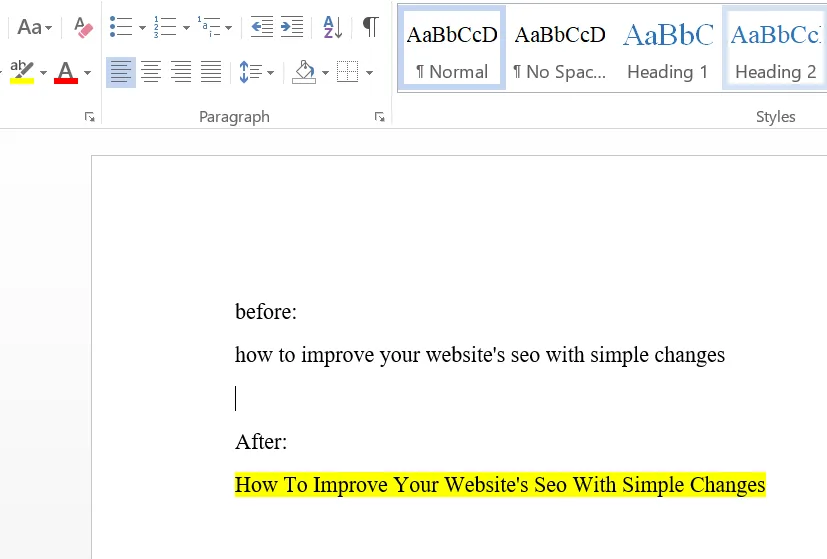
Shift + F3cycles through lowercase, UPPERCASE, and Capitalize Each Word. The Change Case menu also offers sentence case and tOGGLE cASE.
2. Google Docs
- Steps: Go to Format > Text > Capitalization.
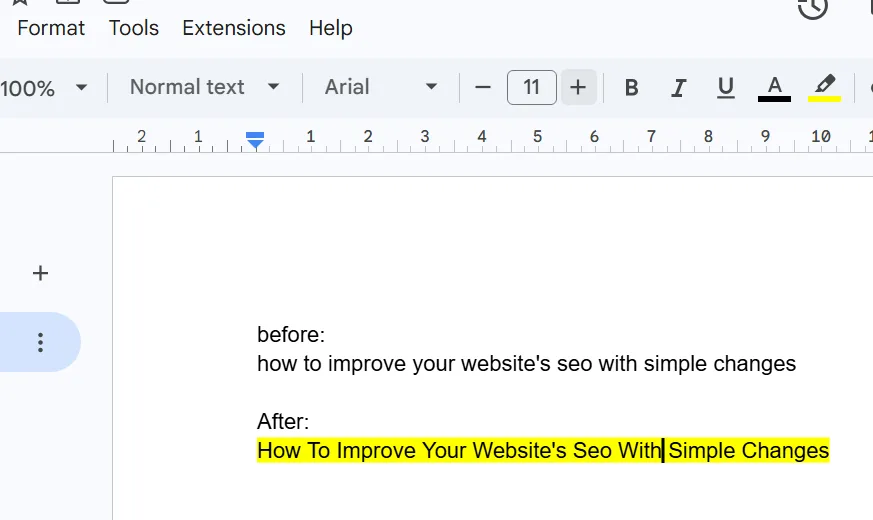
- Result: Offers lowercase, UPPERCASE, and Title Case.
3. Microsoft Excel
- Steps: In an empty cell, enter =PROPER(A1), where A1 is the cell that contains your text.
- Result: Capitalizes the first letter of every word and lowercases the remaining letters. For example, SEO becomes Seo. It also capitalizes a letter after an apostrophe, so "website's" becomes "Website'S."
My test: I ran the same headline through each tool: "how to improve your website's seo with simple changes"
Microsoft Word: Capitalization Example
Google Docs: Capitalization Example
Microsoft Excel: Capitalization Example
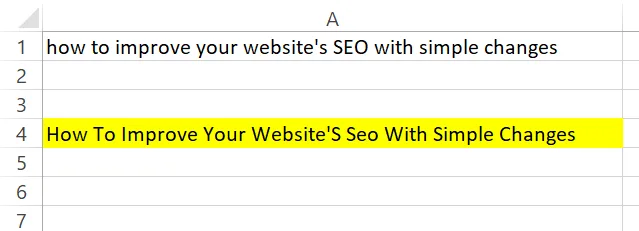
Each tool uses its own capitalization rules, and none of them follows a specific style guide. Excel's PROPER function, for example, even capitalized the "s" in "website's," which no style guide would do. That's why you should always check small words, proper nouns, and acronyms manually.
FAQs
Is it okay to write headings in all caps?
It's usually better to avoid all caps in headings. All caps can be harder to read in longer text and may come across as too strong. Use bold text or a larger font size for emphasis instead.
How do I capitalize brands like iPhone or eBay?
Follow the way the brand writes its name. For example, write iPhone and eBay rather than Iphone or Ebay. If a brand name looks awkward at the beginning of a heading, rephrase the heading when possible.
Should URLs follow title case or sentence case?
Neither. Use lowercase letters in URLs and keep your URL format consistent. Some servers treat uppercase and lowercase URLs as different addresses, which can lead to duplicate URL versions.
Conclusion: Which One Should You Pick?
Both styles are correct, so the right choice depends on your brand voice. Sentence case offers a straightforward look, while title case gives headings a more traditional appearance. Choose the style that best fits your website and stick with it.