
You have written an entire article on your topic, but you are struggling to write a conclusion. This is often the hardest part. A poorly written or confusing conclusion can easily frustrate your readers.
Your conclusion must be strong and clear. It is the final part of the article that readers see, and the part they are most likely to remember.
In this article on how to write a good conclusion, you will learn a simple 3-part formula and a “fill-in-the-blank” template. You will also see real-world examples for essays, blogs, emails, speeches, and more, and learn which mistakes to avoid.
The Short Answer: What a Good Conclusion Actually Does
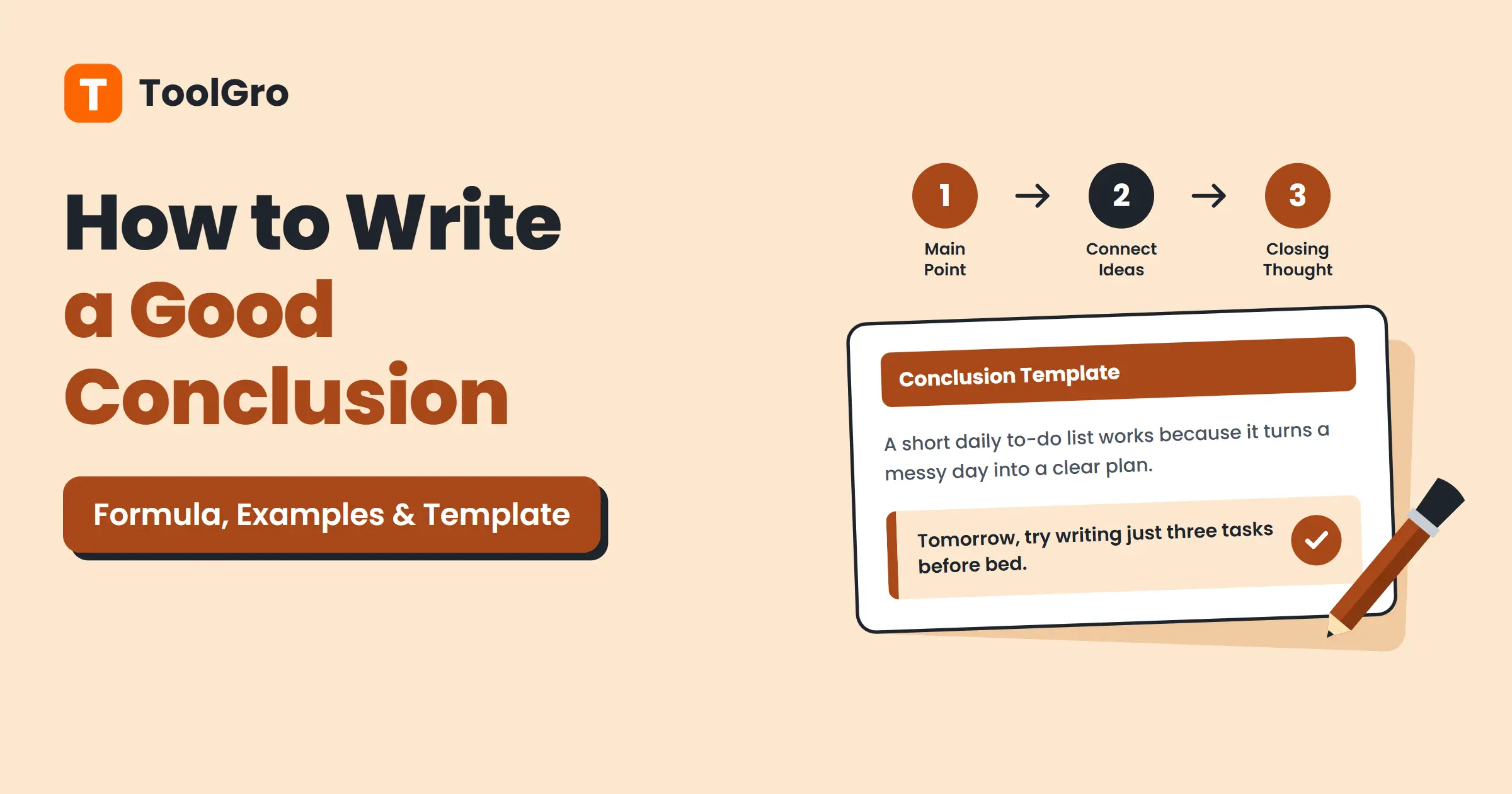
The 3-Part Formula for Writing a Strong Conclusion
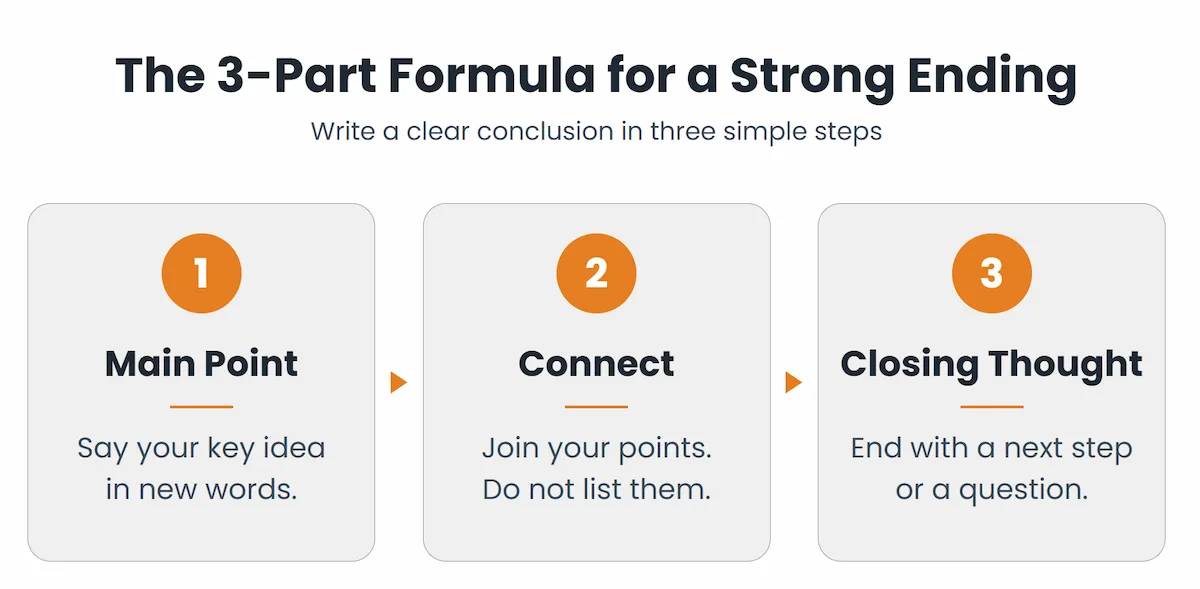
A strong ending only needs three simple steps. Here is how each one works.
Start with the Main Point, Not a Summary Dump
Begin with the one idea you most want your reader to remember, and say it in new words. Do not simply rewrite your introduction.
Connect the Key Ideas
In your article, you likely covered several different points. Bring these points together and draw a conclusion from them. You can mention your key points briefly, but connect them instead of listing them one by one.
Descriptive vs Analytical Conclusion
A descriptive conclusion only repeats what you already said, point by point.
An analytical conclusion joins the points together and shows what they mean as a group.
Imagine your article is about why students feel sleepy in class. You wrote about three things: late-night phone use, skipping breakfast, and early school start times.
Students use phones late at night. They also skip breakfast. School also starts very early.
All three habits drain a student’s energy: less sleep, less fuel, and no time to recover. Together they work as one cycle, so improving one habit can help the others.
The first version is a list. The second shows how the ideas connect. It gives the reader something new to think about without adding any new facts.
Finish with a Closing Thought
Show the reader where all of this leads. Then say what the next steps should be, based on what you have learned. You may also pose a question for your reader.
A Fill-in-the-Blank Template You Can Use
Stuck on your final paragraph? Copy this and fill in the blanks:
The Blank Template
A Filled-in Example (Topic: Daily To-Do Lists)
Now try it with your own topic.
Conclusion Examples for 6 Different Situations
These are sample conclusions. The study and numbers in them are made up for practice.
School Essay
Why it works: It returns to the thesis (main argument) in fresh words and ends with a clear closing thought.
Research Paper
Why it works: It states the finding, admits the limit, and points to what research should do next.
Blog Post
Why it works: The reader leaves with a simple step they can take right now.
Speech
Why it works: A simple picture and a short final line leave an emotional mark.
Why it works: It makes a single request with a deadline, so the reader knows exactly what to do.
Presentation
Why it works: It gives one key takeaway and one action to follow.
A Real Example from My Own Blog
Here is the conclusion from my post on blog introduction examples.

Why it works: It opens with the main point, gives one clear next step, and ends with a closing thought about keeping your own voice.
A Weak Conclusion, Fixed Step by Step
Before
Three Fixes
- Remove the generic (too common, nothing special) opener. Drop “Now in conclusion, I want to sum up...” and start with your main point.
- Make vague (unclear) claims specific. Change “isn’t annoying anymore” and “till the end” to “easy when you follow the steps in order.”
- Add a real closing thought. Replace “I hope you liked my guide, thanks and comment below!” with one clear action the reader can take.
After
Ways to Open Your Conclusion Without Saying “In Conclusion”
I collected some conclusion opening lines from three sources and used them to make this table: EssayService, Thesaurus.com, and New Assignment Help.
| Formal | Casual | Persuasive |
|---|---|---|
| In summary | In a nutshell | Here’s the bottom line |
| As demonstrated above | Put simply | If there’s one thing to remember |
| Briefly | Long story short | The takeaway here is |
| Taken together | At the end of the day | Ultimately |
| In closing | When it comes down to it | For these reasons |
Use formal phrases for essays and reports. Use casual ones for blogs and emails. Choose persuasive ones (phrases that convince) when you want the reader to act.
How Long Should Your Conclusion Be?
A Simple Rule to Follow
The content of your conclusion matters more than its length, and it is okay if it runs a bit longer than the ranges below. I personally try to stay under 100 words.
The University of West London’s study guide suggests a simple rule for essays. Unless you have a specific word count, the introduction and the conclusion should each be about 10% of the total length.
Source: Writing an introduction and conclusion | University of West London
This rule is a general guide for essays. In practice, many conclusions land closer to 5–10%, as the table below shows. For blogs, emails, and speeches, the table is a better guide.
Length by Content Type
| Content type | Typical conclusion length |
|---|---|
| School essay | Generally around 5–10% of the word count (about 50–100 words in a 1,000-word essay) |
| Research paper | Usually 1–2 short paragraphs (3–8 sentences). Some guides suggest around 5% of the whole paper. |
| Blog post | Usually one short paragraph, around 50–100 words |
| Speech | Usually 5–10% of your speaking time (about 30–60 seconds in a 10-minute speech) |
| Usually 1–3 sentences | |
| Presentation | Usually around 10–15% of the speaking time |
These ranges come from writing and public speaking guides, except for blog posts and emails, which are general estimates.
If your conclusion is much longer than these ranges, it may be doing the body’s job. Trim it back to the main takeaway.
6 Mistakes That Weaken Your Final Paragraph
- Adding something new.
A new fact, or finishing an argument you started earlier, confuses the reader.
Fix: If it matters, move it to the body and only tie together what you already said. - Writing too much.
Extra words and lines copied from the introduction make the ending heavy.
Fix: Cut every sentence that repeats something you already said. - Using vague words.
Phrases like “many things” or “I think maybe” sound unsure.
Fix: Say only what you can stand behind, in plain words. - Sounding apologetic.
Lines like “I couldn’t cover everything” make readers doubt your article.
Fix: End with confidence, because a point that mattered should already be in the body. - Ending too dramatic or preachy (like giving a lecture).
Big lines like “The future of the world depends on this!” feel fake.
Fix: Close with a simple, honest thought. - Forgetting the question.
If your title asks something, the reader expects an answer.
Fix: Reread your title, then check that your conclusion answers it.
Final Check Before You Publish
Before you publish, read your conclusion once more with these questions in mind.
- Is the main point clear?
- Are all ideas connected?
- Did you avoid adding any new argument?
- Is it short enough for your content type?
- Is the opening free of generic phrases?
- Is there a closing thought?
- Does the tone match the rest of the article?
- Does the reader know what to do next?
Common Questions People Ask About Conclusions
What makes a good conclusion?
A good conclusion leaves the reader with one clear takeaway. It begins with your main point, written in a new way, and connects your key ideas instead of repeating them. It ends with a closing thought or next step. It stays short, adds no new facts, and matches the tone of your article.
How do you start a conclusion sentence?
Start with your main point instead of “In conclusion.” You can use a simple opener like “In summary,” “Put simply,” or “Here’s the bottom line,” then state your key takeaway right away. Pick one from the table above that matches your tone.
Can a conclusion include a question or quote?
Yes, both work if used carefully. A question makes the reader think, and a short quote (someone else’s exact words) adds weight. Keep the quote brief, relevant, and credited to its source. Never use them to add new ideas. They should support your main point and close the article.
One Last Thing Before You Write Yours
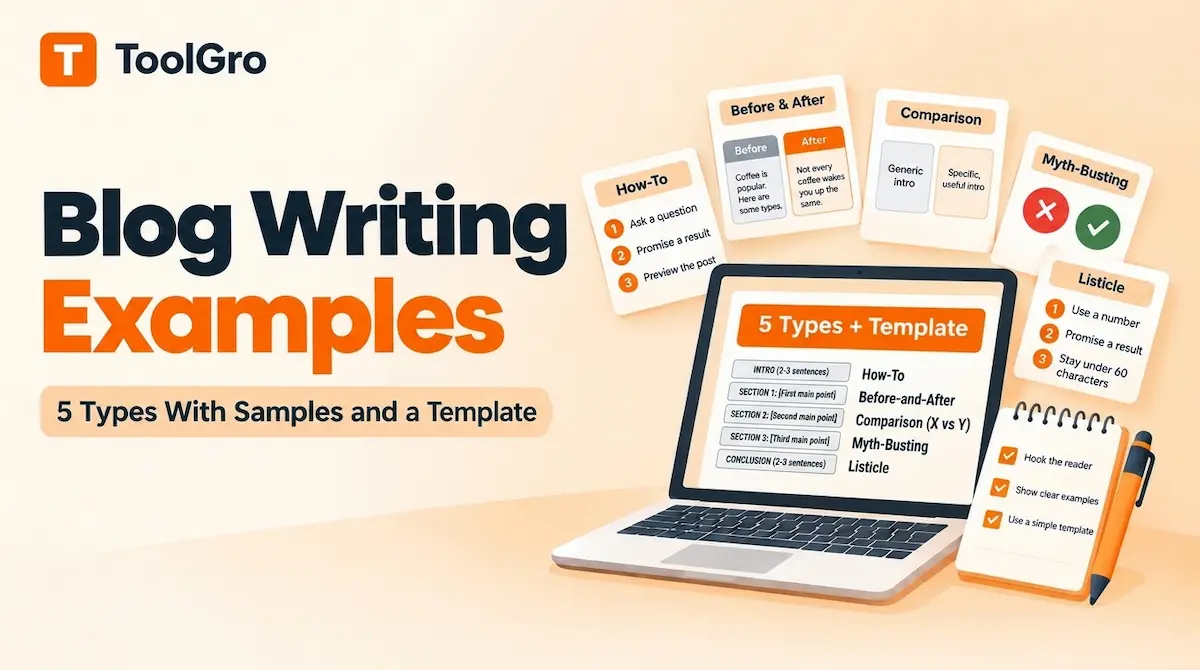
Keep your conclusion short and focused on one clear idea. A good ending also needs a good beginning and a clear structure, so check out these blog writing examples next.